Liposomal plant extracts combine active plant-derived substances with technology based on phospholipid structures. Unlike classic extracts, where the properties of active ingredients depend, among other things, on their solubility and stability, liposomal formulation allows for their incorporation into the lipid system. This is significant for the physicochemical properties of the formulation, its stability, and the method of delivering active ingredients. However, the final quality of such a system is determined not only by the presence of phospholipids but also by the manufacturing technology, particle characteristics, standardization, and control of the finished formulation.
Table of Contents
How Do Liposomes Increase the Bioavailability of Active Ingredients?
The Use of Liposomes in Drug and Supplement Manufacturing
Not All Liposomes Are Equal – What Affects the Quality of Liposome-Based Preparations?
How Do Liposomal Herbal Supplements Differ from Classic Extracts?
Currently, scientists have managed to confirm the health-promoting activity of many chemical compounds present in plants. Their effect on cells can be certain, but a constant problem associated with phytotherapy is the bioavailability of beneficial ingredients. Many researchers are now focusing on finding the most favorable routes for administering active compounds, increasing absorption efficiency, improving bioavailability, and developing technologies for formulating herbal supplements and medicines. One of the most beneficial forms of preparations in terms of absorption are products based on liposomes1.
The most appropriate form for taking herbal supplementation is oral. Food and biologically active ingredients, after consumption, are digested and then absorbed in the gastrointestinal tract. Unfortunately, when considering supplementation and phytotherapy, we must be aware that a large proportion of important molecules are poorly absorbed. Many oral medications and herbal compounds have very low absorption levels. For some substances, less than 10% of molecules are absorbed into the bloodstream1.
The absorption of active molecules into the bloodstream depends on their water solubility, their lipophilicity (ability to dissolve in fats), as well as the rate of their penetration through cell membranes, stability against various enzymes (susceptibility to metabolic processes of the body), and resistance to acids and bases. Liposomes, by protecting molecules from degradation and increasing their ability to pass through cell membranes, enhance the bioavailability of plant supplementation1,2.
What are liposomes?
Liposomes are spherical forms that can encapsulate bioactive substances. They are most often formed from phospholipid molecules (components of cell membranes that build our bodies). Liposomes are successfully used to change the pharmacokinetic profile of drugs, as well as herbs and vitamins. Due to their unique properties, liposomes are capable of enhancing the efficacy of plant substances by increasing their solubility, improving bioavailability, and increasing their stability in the human body2.
Inside, liposomes encapsulate a fraction of the solvent, which may contain active substances. They can have one, several, or many spherically enclosed internal membranes. Liposomes are composed of polar lipids, which are characterized by having a lipophilic and a hydrophilic group. This means that one pole adheres to water-soluble substances, and the other to fat-soluble substances. Under the influence of water, polar lipids self-organize and form vesicular structures2,3.
How Do Liposomes Increase the Bioavailability of Active Ingredients?
A liposome has an aqueous core surrounded by a hydrophobic lipid bilayer membrane. Hydrophilic substances dissolved in the core cannot easily pass through the bilayer, thus being protected from external factors. Hydrophobic chemicals (not water-soluble, fatty) bind to the lipid bilayer. This allows them to disperse in an aqueous environment and be more easily absorbed by the body. This means that the liposomal form of a herbal preparation increases the bioavailability of both fat-soluble and water-soluble ingredients. During the delivery of active molecules to the site of action, the liposome’s lipid bilayer merges with other bilayers, such as the cell membrane, thereby delivering the vesicle’s contents1–3.
In summary, the beneficial effect of liposomes on nutrient bioavailability results from several mechanisms of action. These include:
- increased solubilization of the active substance;
- protection of active ingredients from degradation;
- increased absorption of the active substance into the bloodstream.
Liposomes in Nature
A wonderful example of a natural nutrient fluid containing liposomes is human milk. Due to its unique properties, this secretion has been thoroughly studied by scientists for decades. As a result of this scientific work, the components of human milk and their relationship to infant health and development are very well understood. Analyses of the chemical composition of human milk have shown that it is an extremely complex suspension containing over 200 fat-soluble and water-soluble components. The dominant forms in milk are emulsion droplets and casein micelles. Recently, electron microscopy studies have also detected lipid vesicles (liposomes) in it1.
The Use of Liposomes in Drug and Supplement Manufacturing
Until recently, the application of liposomes in medicine primarily concerned targeted drug delivery. This term refers to preparations designed to selectively act on specific cell types, e.g., cancer cells. In recent years, there has been a clear trend of using the properties of liposomes to increase the effectiveness of dietary supplements and herbal preparations. This new approach stems from the problem of low absorption rates and bioavailability of traditional oral dietary tablets and capsules. Unfortunately, the low bioavailability of orally administered supplements is a well-documented issue in clinical test results. For this reason, the natural ‘encapsulation,’ on a microscopic scale, of lipophilic and hydrophilic nutrients in liposomes is an effective method of protection against destructive enzymes and acids secreted by the digestive system. Additionally, encapsulating substances in liposomes increases the efficiency of their delivery to cells and tissues4.
Not All Liposomes Are Equal – What Affects the Quality of Liposome-Based Preparations?
It should also be noted that there are certain factors influencing the percentage content of liposomes in a preparation, their stability, and the actual amount of active substance encapsulated. These include:
- method of liposome production and preparation;
- composition, quality, and type of phospholipid used for formulating and manufacturing liposomes;
- content of homogeneous-sized liposomal vesicles in the preparation that are stable and maintain their encapsulated cargo.
The listed elements form the basis for developing effective liposomal carriers used in the production of supplements and foods for special dietary uses.
The most important types of liposomes include multilamellar vesicles (MLV), small unilamellar vesicles (SUV, with a single lipid bilayer), and large unilamellar vesicles (LUV). For drugs and supplements, multilamellar liposomes are the least desirable form. This is because MLVs are large vesicles containing more smaller ones, which hinders access to the active substance.
Among liposomes found in orally administered preparations, unilamellar vesicles are the most advantageous form. Among these, LUV liposomes with a diameter greater than 50 nm are distinguished. They show greater stability during storage than small SUV vesicles because, due to their larger size, they do not experience high stresses at the level of the lipid bilayer. LUVs can be successfully used as carriers for active substances due to the optimal ratio of the aqueous to the lipid phase. Additionally, the lipid membrane of LUV vesicles shows great similarity to the cell membrane of human cells3.
Laboratory Tests – Particle Size Analysis (DLS) and Nanoemulsion Stability
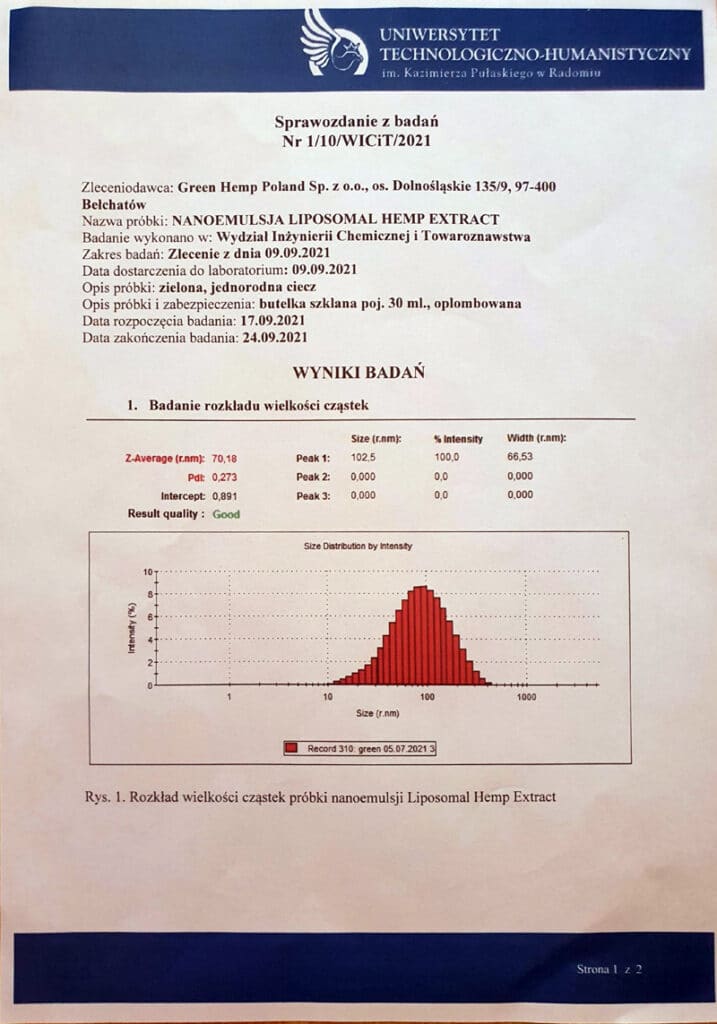
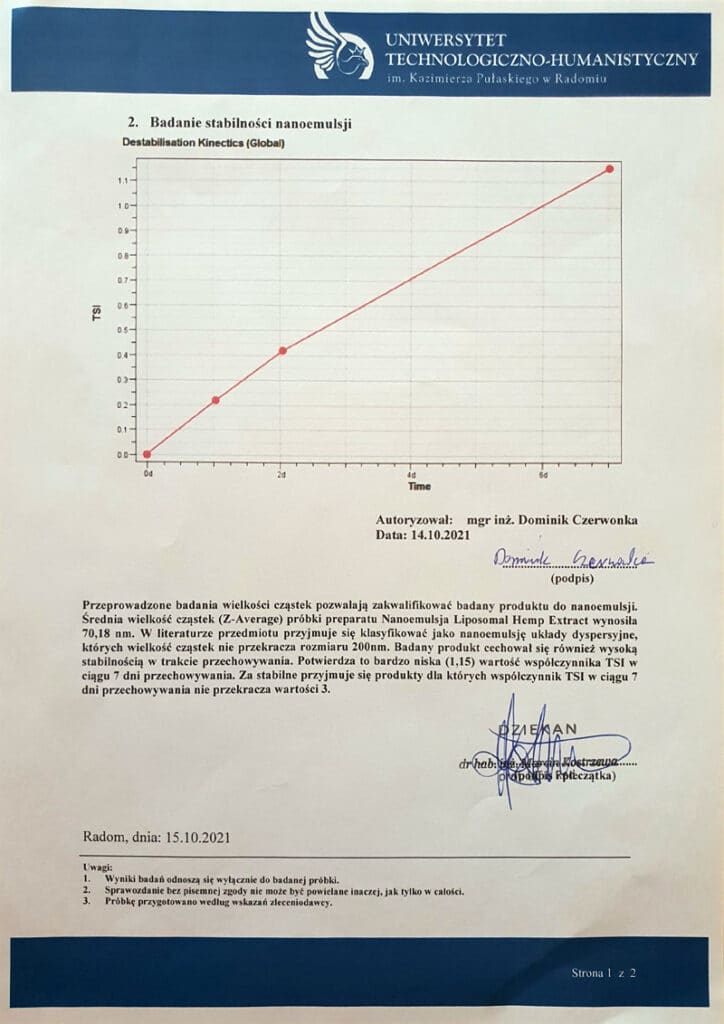
Tests conducted in the laboratory of Kazimierz Pułaski University of Technology and Humanities in Radom showed that the tested Liposomal Nanoemulsion was characterized by an average vesicle size of 70.18 nm. This means that it is classified into the category of LUV liposome-based preparations, which is associated with a beneficial increase in the absorption of both lipophilic and hydrophilic components. Additionally, the laboratory confirmed the high stability of the nanoemulsion, which is one of the most important quality parameters for liposome-based preparations. At the same time, it was shown that the vesicles in the preparation are small enough to qualify it as a nanoemulsion. This term defines a system in which the size of dispersed particles does not exceed 200 nm. Nanoemulsions are characterized by the ease of introducing biologically active compounds, both into the internal phase and the dispersing phase, which favorably affects their bioavailability5.
The liposomal nanoemulsion described in the above study forms the basis of the technology used in the preparation:
Raw Materials Used in Liposomal Technology
We discuss the detailed characteristics of specific plant extracts and their properties in the raw materials and ingredients section, where we present, among others, vitamin C, ashwagandha, betulin, and Japanese knotweed.
If you want to better understand the technological differences between individual formulations, also see the article Liposomal Supplements: How Do Liquid and Powder Forms Differ?, in which we discuss the importance of particle size, system stability, and laboratory tests.
Content Development
Article prepared in collaboration with a Doctor of Pharmacy.
The content is educational and based on current data regarding liposomal technology, nanoemulsions, and the bioavailability of plant compounds.
Dr. Sara Janowska, PharmD
References
Idzikowska, M. et al. NANOTECHNOLOGY IN FOOD PRODUCTION—DIRECTIONS OF DEVELOPMENT, THREATS, AND LEGAL REGULATIONS. (2012).
Keller, B. C. Liposomes in nutrition. Trends in Food Science & Technology 12, 25–31 (2001).
Porter, C. J. H., Trevaskis, N. L. & Charman, W. N. Lipids and lipid-based formulations: optimizing the oral delivery of lipophilic drugs. Nature Reviews Drug Discovery 2007 6:3 6, 231–248 (2007).
Small particle technology – liposomes, microparticles, microcapsules, microspheres, lipid nanoparticles. – Aptekarz Polski. https://www.aptekarzpolski.pl/wiedza/technologia-malych-czastek-liposomy-mikroczastki-mikrokapsulki-mikrosfery-nanoczastki-lipidowe/.
DeFelice, S. L. The nutraceutical revolution: its impact on food industry R&D. Trends in Food Science & Technology 6, 59–61 (1995).